


Construction outsourcing in Australia began with estimating. Builders facing a shortage of local estimating talent — and project pipelines that could not wait for a 60 to 90 day local search — placed offshore estimators to handle quantity takeoffs and cost estimates. The model worked, and the conversation expanded.
According to the AGC/Sage 2026 Construction Hiring and Business Outlook, 80% of US construction firms report having a hard time filling salaried openings — a figure that reflects conditions experienced across Australian and US construction markets alike. The supply of qualified construction professionals has not kept pace with project demand, and the gap is not closing. (Source: Associated General Contractors of America, 2026 Construction Hiring and Business Outlook, agc.org)
Australian builders who started with offshore estimating support have, in many cases, expanded into document control, procurement support, and contract administration. This guide explains how construction outsourcing works across each function.
Why the construction back-office is often the hidden bottleneck
Construction is an industry where the visible work — the physical build — is well-resourced. Project managers, site supervisors, subcontractors. The resources follow the work that is directly visible on site.
The back-office that supports the build is frequently under resourced relative to the operational complexity it manages. A mid-tier builder managing five active projects simultaneously has five drawing registers, five subcontractor schedules, five RFI logs, and five sets of progress claims to manage. The back-office supporting that activity is often one or two people handling it alongside other responsibilities.
Construction outsourcing services address this imbalance by adding dedicated capacity to the back-office functions that are chronically short of it.
Estimating and quantity surveying
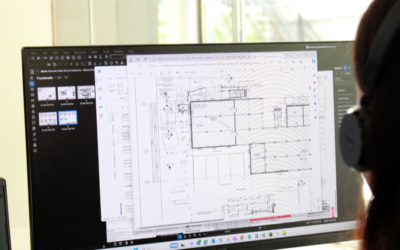
The most established application of construction outsourcing in Australia. Offshore estimators working in Bluebeam, ProEst, and equivalent platforms produce quantity takeoffs and cost estimates that the in-house senior estimator reviews and finalises.
The offshore professional handles volume work — the detailed takeoff from drawings, the compilation of quantities, the preparation of the pricing schedule. The senior estimator handles the judgement calls: which subcontractor relationships to rely on, which margins apply to this job type, which items carry risk that the pricing should reflect.
This division of labour allows the in-house estimating function to produce more bids in a given period without proportional growth in senior estimating headcount.
Document control
Managing the drawing register, distributing documents to subcontractors and consultants, maintaining version control, tracking RFI responses, and managing the document flow that keeps a construction project compliant and coordinated.
In larger builds, document control is a full-time function. In most mid-tier construction businesses, it is absorbed by someone already doing something else — usually the site manager or office administrator. The consequence is a drawing register that runs behind, RFIs that are not systematically tracked, and subcontractors receiving incorrect drawing revisions.
A dedicated offshore document controller gives the site team a resource whose sole job is to keep the document register accurate and current.
Procurement support
Obtaining subcontractor and supplier quotes, maintaining the preferred supplier database, tracking pricing movements, preparing purchase orders, and managing the procurement documentation that sits behind every contract.
Procurement in most construction businesses is absorbed by the project manager between site visits and the estimator between takeoffs. The result is a procurement function that gets done, but does not get done consistently — quote follow-up slips, supplier rates are not regularly benchmarked, and purchase orders are raised retrospectively.
An offshore procurement professional gives the project team a dedicated resource for the sourcing and administrative components of procurement, freeing project managers for the work that requires their experience and site relationships.
Contract administration support
Preparing progress claims, processing variations, tracking contractual milestones, and managing the contract administration documentation that protects the builder’s commercial position.
Contract administration is one of the highest-value back-office functions in construction and one of the most consistently under resourced. Missed variation claims, late progress claims, and incomplete milestone documentation all have direct commercial consequences. A dedicated offshore contract administrator reduces these risks by giving the function consistent attention rather than relying on project managers to manage it alongside everything else.
What to expect across the first three months
The pattern across construction businesses that have placed dedicated offshore back-office support is consistent.
In the first month, the offshore professional learns the business’s specific systems, preferred suppliers, project types, and documentation standards. Output is supervised closely. Volume is limited. The investment is in context, not throughput.
By month two, the routine functions are running independently. Takeoffs come back with fewer clarifying questions. The drawing register is current without the site manager needing to prompt an update. Procurement quotes are tracked without chasing.
By month three, the offshore professional is contributing beyond the task — flagging inconsistencies in subcontractor quotes, noting when a drawing revision has not been distributed to all relevant parties, identifying a variation that has not been formally claimed. This proactive contribution develops from institutional knowledge, which develops from time and deliberate context-building.
Common mistakes in construction outsourcing
- Insufficient briefing before day one — the offshore professional learns the firm’s approach from the client, not from generic construction knowledge
- Expecting full productivity in week one — the first two weeks are context-building, not throughput
- Treating the offshore professional as a task processor rather than a team member — the contribution compounds when the professional is given context and communication
- Not defining the scope clearly — overlapping responsibilities between the offshore professional and in-house staff create gaps rather than filling them
Businesses should obtain advice relevant to their circumstances when structuring offshore staffing arrangements for construction operations.
Global Staff Network places experienced offshore construction professionals for Australian building firms across estimating, document control, and contract administration. Learn more about offshore construction estimating and back-office support.
Frequently Asked Questions
What software do offshore construction estimators use?
Most offshore estimators placed through managed providers are proficient in Bluebeam Revu for digital takeoff from PDF drawings, and in pricing platforms such as ProEst, Buildsoft, or Excel-based estimating systems. The specific software used depends on what the building firm’s estimating function uses — the offshore professional works within the client’s existing tools.
How does construction outsourcing handle Australian building codes and standards?
Offshore construction professionals are briefed on the client firm’s relevant standards, specifications, and documentation requirements as part of onboarding. For estimating, this includes the client’s preferred unit rates, standard specifications, and margin philosophy. Compliance with the National Construction Code and relevant Australian Standards is the responsibility of the qualified local professionals who review and approve work.
How long before an offshore estimator is fully productive?
Most offshore estimators reach productive, largely independent output in weeks three to four when onboarding has been properly structured — rate books shared, historical job files reviewed, preferred suppliers documented. Complex or unusual project types may take longer.
Can offshore professionals work across multiple functions in construction?
Yes. Many construction businesses place offshore professionals who handle a combination of estimating support, document control, and procurement administration. The specific scope depends on the business’s needs and the professional’s qualifications and experience.





0 Comments