

Why Most Australian Builders Still Lose Money on Estimating – and How Outsourcing Fixes It
Most Australian builders know their estimating function is not as sharp as it should be. They feel it in the tight tenders that turn into thin jobs. In the variations that should have been priced in from the start. In the projects that come in over budget because three line items in the original take-off were rough guesses.
The cause is rarely a lack of estimating talent. It is that the estimator they have — sometimes the owner, sometimes a foreman with a head for numbers, occasionally a part-time professional — is stretched across too many roles to do the job properly.
This is the problem an outsourced construction estimator is built to solve. Not by replacing the local team, but by giving the people who already make the project decisions enough time and clean data to make them well.
Where Estimating Actually Goes Wrong
When margin leaks out of a construction business through estimating, it usually traces back to one of four places.
Rushed take-offs
The tender came in late, the deadline is tomorrow, and the estimator measured the headline quantities and rough-priced the rest. Whatever was missed becomes a margin hit during delivery.
Out-of-date rate libraries
The estimator is using last year’s labour and material rates because no one has updated the cost database. Steel prices moved 8 per cent in three months and no one noticed until the supplier quote came in.
No second pair of eyes
The estimate gets one review from the owner if it is lucky. Single-checked estimates have errors. Always.
The estimator is doing five other jobs
The person quoting your work is also running site, managing subbies, and answering calls from the client. The estimating time is whatever is left at the end of the day. The quality of the work reflects that.
A dedicated outsourced construction estimator addresses the first, third, and fourth points directly. The second one — the rate library — is something the business still has to maintain, but the outsourced estimator becomes the person responsible for keeping it current.
What an Outsourced Construction Estimator Actually Does
A dedicated offshore construction estimator is a full-time member of your team who handles the production end of the estimating function. They are not a service. They are a person, with your business’s name on their inbox, working your hours, in your software.
A typical scope:
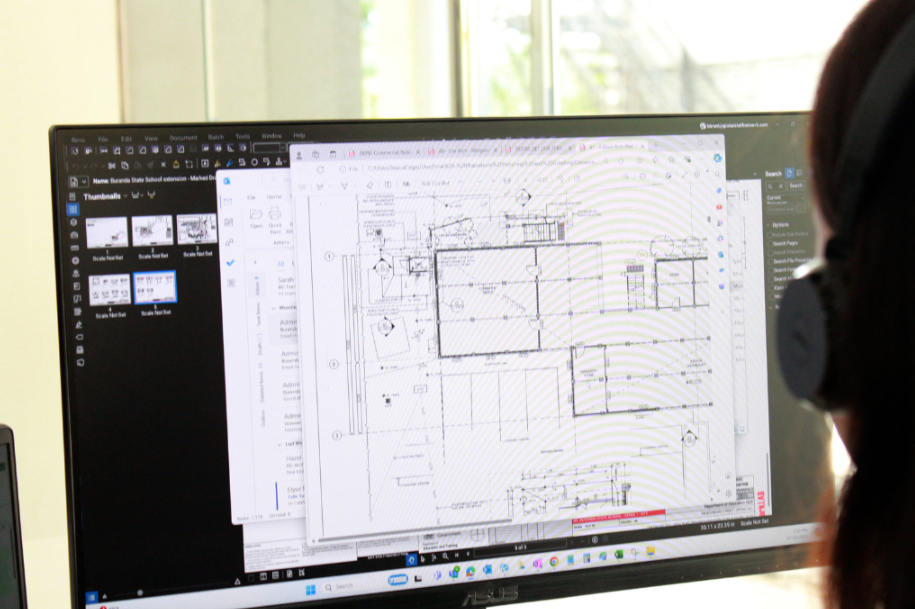
- Quantity take-offs from drawings and BIM models (Bluebeam Revu, On-Screen Takeoff, Cubit, Buildxact, Procore)
- Materials and labour pricing from your rate library
- Subcontractor RFQ packaging and follow-up
- Tender response document preparation
- Cost plans, budget tracking, and variations pricing post-award
- Maintenance of the historical cost database
What stays with your team in Australia is the strategic side — which tenders to chase, how to position the bid, what risk margin to apply, how to manage client conversations. The offshore estimator does not replace the senior estimator or the project manager. They free those people up to do strategic work instead of measuring slabs at 9pm.
The Cost Comparison That Actually Matters
A junior estimator in Sydney or Melbourne costs around $80,000 to $95,000 a year plus super, equipment, and software licences. A senior estimator with commercial experience costs $140,000 to $180,000.
A dedicated offshore construction estimator through GSN typically runs $35,000 to $50,000 a year all-in, depending on seniority and the software stack required. The difference is not just a number on a salary line. It is the difference between hiring one local estimator and running a small team that can actually keep up with the volume of tenders the business is bidding.
For builders doing 30 to 80 tenders a year, the maths almost always favours running an estimating team rather than a single estimator. The team approach is what outsourcing makes affordable.
What This Looks Like in Practice
A mid-sized commercial fit-out builder in Melbourne, around 25 staff, doing roughly 50 tenders a year. The estimating function was a senior estimator (overworked) plus the owner pitching in on bigger jobs. Tender win rate sat at 18 per cent — respectable, but the wins were thinner than they should have been because rushed pricing was leaving margin on the table.
They brought on a dedicated offshore construction estimator through GSN to handle the production work — take-offs, RFQs, document preparation. The local senior estimator shifted from production to oversight, focusing on tender strategy, scope review, and pricing risk decisions.
Three months in, the win rate had moved to 23 per cent and the average gross margin on awarded projects was up 2.4 percentage points. The senior estimator was working sensible hours for the first time in two years. Nothing about the projects had changed except the estimating function had bandwidth.
How to Tell If Outsourcing Estimating Will Work in Your Business
Three things have to be true for an outsourced construction estimator to deliver.
You have to know what you are estimating
Your scope documents, drawing standards, and rate libraries need to be in good enough shape that someone offshore can follow them. If your estimating today relies on the senior estimator’s memory of what worked on the last similar job, that knowledge needs to be written down before you start. Two weeks of cleanup before the engagement saves you three months of frustration during it.
Someone has to review the work
Every estimate from the offshore team needs a second-pair-of-eyes review from your senior estimator or owner before it goes to the client. That review is non-negotiable. If your senior people have no capacity to do it, you are not ready to outsource — you are ready to hire locally first, then outsource.
You have to be bidding enough volume
A dedicated full-time offshore estimator needs roughly 30 to 60 tenders a year to stay busy. If you are doing fewer than that, you might be better served by a part-time arrangement or by outsourcing specific tasks (take-offs only) rather than the full role.
If all three are true, an outsourced construction estimator is one of the highest-leverage hires you can make in an Australian construction business.
What Builders Worry About — And the Honest Answer
Will an offshore estimator know Australian construction?
They will not on day one. They will have the technical skill — quantity take-offs, software fluency, cost planning — but Australian standards, terminology, and supplier patterns take six to ten weeks to learn properly. The firms that get this right invest in onboarding. The firms that try to skip onboarding usually walk away frustrated.
What about data security on tender pricing?
A properly run outsourcing provider operates from a corporate-grade office with controlled access, locked-down USB ports, segregated workstations, and signed NDAs. Tender pricing is not riskier to hand to an offshore estimator than to a casual local hire working from their kitchen. The structure protects the data.
How do they get the drawings?
The same way your local estimator does — shared cloud storage, the tender portal, or a project collaboration platform like Procore or Buildxact. The Manila time zone aligns with the Australian working day, so files land in their inbox the morning you send them.
Thinking about whether your business is ready to outsource estimating?
At Global Staff Network, we build dedicated offshore construction estimating teams from the Philippines for Australian builders — from quantity take-off specialists through to senior commercial estimators. We handle recruitment, onboarding, IT, HR, and ongoing management.
Book a call with our experts to talk through what is possible for your business.
Want to see how outsource construction estimator could work in your business?
At Global Staff Network, we partner with Australian businesses to build dedicated offshore teams from the Philippines. We handle recruitment, onboarding, HR, IT, and ongoing management.




0 Comments