


If you are an Australian business owner looking to scale in 2025, you are likely facing a “perfect storm.” Local talent shortages — especially in construction & engineering, accounting, information technology, and administration — are pushing wages to unsustainable levels, yet the pressure to deliver projects hasn’t slowed.
You know the solution lies offshore, often in the Philippines, which benefits from a favourable time zone for Australian operations. But once you start researching how to hire, you’re quickly hit with an alphabet soup of acronyms: PEO, EOR, BPO, Outsourcing.
Are they the same? No.
Does it matter which model you choose? Absolutely.
Choosing the wrong one can expose your business to unexpected tax bills, Fair Work penalties for “sham contracting,” Permanent Establishment risks, and data privacy liabilities. This guide breaks down the three primary models — Employer of Record (EOR), Professional Employer Organisation (PEO), and Managed Outsourcing — specifically for Australian businesses navigating the post-2024 legal landscape.
1. The Employer of Record (EOR): The “Software” Solution
What is an EOR?
An Employer of Record (EOR) is a third-party organization that acts as the legal employer of your overseas staff for tax and compliance purposes. You find the candidate (usually yourself, via LinkedIn or JobStreet), and the EOR puts them on their local payroll. They handle the “admin” side of employment: taxes, statutory benefits, and salary disbursement.
Popular examples include venture-backed software platforms like Deel or Remote.com.
The Pros:
- Fast onboarding: You can onboard a single hire in days.
- No Entity Needed: You don’t need to register a company in the Philippines to hire legally.
The Cons for Australian SMEs:
- Cost at Scale: EORs typically charge a monthly fee per employee (often $500–$800 USD) plus the cost of the salary. While this is fine for one person, as soon as you scale to 5 or 10 staff, the fees alone can cost you $60,000+ per year—before you’ve even paid a single salary.
- You Are the Recruiter: EORs generally do not source talent. You still have to spend hours sifting through CVs or pay a separate recruitment fee to a headhunter.
- Limited Management: They handle payroll, not people. If your staff member underperforms, goes AWOL (“ghosting”), or has a grievance, the EOR software offers little operational support.
- Hidden FX Fees: Many EOR platforms charge significant foreign exchange spreads when converting your AUD to PHP, adding a “hidden tax” to every invoice.
Verdict: Best for hiring one freelancer or specialist for a short-term project, but too expensive for building a team.
2. Professional Employer Organization (PEO): The “Co-Employer”
What is a PEO?
A PEO enters into a “co-employment” relationship with you. In this model, the PEO handles HR tasks like benefits, payroll, and workers’ compensation, but you (the client) retain a direct employment relationship with the staff.
The “Gotcha” for Australian Businesses:
There is a massive misconception here, often caused by US-centric marketing. In most countries, including the Philippines, to use a true PEO model, you must already have a registered legal entity in that country.
If you are a Sydney-based construction firm or a Melbourne accounting practice, you likely do not have a registered corporation in the Philippines. Therefore, for 95% of Australian SMEs, a PEO is not even a legally viable option. Unless you plan to incorporate a subsidiary in Manila (which brings its own tax and audit nightmares), you should likely avoid the PEO path.
Verdict:
✔ Works only if you are willing to incorporate in the Philippines
✘ Not an option for 95% of Australian SMEs
3. Managed Outsourcing (The Global Staff Network Model)
What is Managed Outsourcing?
Managed Outsourcing (often called “Staffing” or “BPO”) is a holistic service. A partner like Global Staff Network acts as both the legal employer and the operational manager.
Unlike an EOR, we don’t just process payroll. We:
- Source the Talent: Our specialized recruiters find candidates specifically for your niche like Estimators, Accountants, Virtual Assistants, Web Developer, and Digital Marketing.
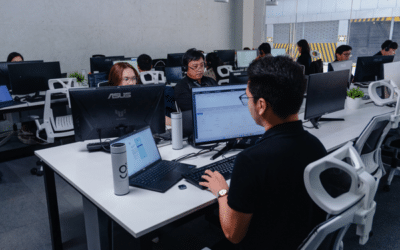
- Provide the Infrastructure: Your team works from our “safe and secure office facilities” in Davao City, equipped with enterprise-grade internet, redundant power, and data security protocols.
- Manage the Operations: We handle IT security, HR disputes, retention programs, and performance management.
The Strategic Advantage for 2025:
- Risk Mitigation (Closing Loopholes Act):
With the Australian Government’s recent Closing Loopholes Act and “Same Job, Same Pay” legislation, the line between a “contractor” and an “employee” is thinner than ever. Using a Managed Outsourcing partner creates a clear B2B service agreement. The staff are legally employed by us in the Philippines, creating a distinct legal buffer that protects your Australian entity from misclassification claims. - Data Sovereignty (APP 8):
Under APP 8 (Australian Privacy Principles), you are responsible for taking reasonable steps to ensure overseas recipients of data do not breach Australian privacy laws. An EOR employee working from a kitchen table on public WiFi poses a significant risk. In contrast, a Managed Outsourcing provider offers a controlled office environment with firewalls, clean-desk policies, and biometric access—demonstrating your commitment to data security. - Cost Efficiency:
Managed Outsourcing typically operates on a “seat leasing” or “cost-plus” model. This is often significantly cheaper than the EOR per-head fee structure, especially as you scale. You pay a transparent flat rate that bundles the salary, the office space, the hardware, and the management support.
Comparison Matrix: At a Glance
|
Feature |
Employer of Record (EOR) |
Managed Outsourcing (GSN) |
|
Primary Function |
Payroll & Tax Compliance |
Recruitment, Facilities & Management |
|
Who Finds the Talent? |
You (DIY) |
We do (Specialized Recruiters) |
|
Work Location |
Work From Home (Employee’s house) |
Secure Office (Davao CBD) |
|
IT & Equipment |
Employee provided (BYOD) |
Enterprise Hardware Provided |
|
Legal Structure |
Legal Employer (Paperwork only) |
Legal Employer + Operational Manager |
|
Cost Model |
High Monthly Fee + Salary |
Bundled Service Fee |
|
Data Security |
Low (Personal Devices) |
High (Corporate Network) |
The Verdict: Which Should You Choose?
The decision comes down to your long-term goals.
If you need to pay a single graphic designer you found on Upwork for 10 hours a week, use an EOR. It’s quick, easy, and low-commitment.
However, if you are building a team—if you need to hire 3 estimators, 2 accountants, and a virtual assistant to genuinely scale your Australian business—then Managed Outsourcing is the safer, more sustainable choice. It gives you the control of your own team without the “DIY” headaches of recruitment, IT setup, and legal compliance.
Ready to build your team?
Don’t just hire a payroll login. Hire a partner. Contact Global Staff Network today to discuss your offshore roadmap.




0 Comments